C "Programming" How to Read Partition Table in First Boot Sector
A principal kick record (MBR) is a special blazon of boot sector at the very kickoff of partitioned reckoner mass storage devices like fixed disks or removable drives intended for apply with IBM PC-compatible systems and beyond. The concept of MBRs was publicly introduced in 1983 with PC DOS two.0.
The MBR holds the information on how the logical partitions, containing file systems, are organized on that medium. The MBR also contains executable lawmaking to part as a loader for the installed operating system—usually by passing control over to the loader'southward second stage, or in conjunction with each partition's volume kicking record (VBR). This MBR lawmaking is commonly referred to as a boot loader.[one]
The organisation of the sectionalization table in the MBR limits the maximum addressable storage space of a partitioned disk to two TiB (232 × 512 bytes).[2] Approaches to slightly raise this limit assuming 32-bit arithmetics or 4096-byte sectors are not officially supported, as they fatally suspension compatibility with existing boot loaders and most MBR-compliant operating systems and system tools, and tin can cause serious information corruption when used outside of narrowly controlled system environments. Therefore, the MBR-based segmentation scheme is in the procedure of existence superseded by the GUID Division Table (GPT) scheme in new computers. A GPT tin can coexist with an MBR in lodge to provide some express form of astern compatibility for older systems.
MBRs are not present on non-partitioned media such as floppies, superfloppies or other storage devices configured to acquit every bit such.
Overview [edit]
Support for partitioned media, and thereby the principal kick record (MBR), was introduced with IBM PC DOS 2.0 in March 1983 in lodge to support the 10 MB hard disk of the then-new IBM Personal Figurer XT, however using the FAT12 file system. The original version of the MBR was written by David Litton of IBM in June 1982. The partition table supported upwardly to iv primary partitions, of which DOS could but utilise one. This did not change when FAT16 was introduced as a new file system with DOS 3.0. Support for an extended partition, a special primary partitioning type used equally a container to hold other partitions, was added with DOS 3.2, and nested logical drives inside an extended partition came with DOS iii.xxx. Since MS-DOS, PC DOS, OS/2 and Windows were never enabled to boot off them, the MBR format and boot lawmaking remained almost unchanged in functionality, except for in some third-party implementations, throughout the eras of DOS and OS/2 up to 1996.
In 1996, support for logical block addressing (LBA) was introduced in Windows 95B and DOS 7.10 in order to support disks larger than 8 GB. Disk timestamps were also introduced.[three] This also reflected the idea that the MBR is meant to be operating system and file system independent. However, this blueprint rule was partially compromised in more recent Microsoft implementations of the MBR, which enforce CHS access for FAT16B and FAT32 partition types 0x06/0x0B, whereas LBA is used for 0x0E/0x0C.
Despite sometimes poor documentation of certain intrinsic details of the MBR format (which occasionally caused compatibility bug), information technology has been widely adopted as a de facto industry standard, due to the wide popularity of PC-uniform computers and its semi-static nature over decades. This was even to the extent of being supported past computer operating systems for other platforms. Sometimes this was in addition to other pre-existing or cross-platform standards for bootstrapping and partition.[iv]
MBR partition entries and the MBR boot code used in commercial operating systems, however, are express to 32 bits.[2] Therefore, the maximum deejay size supported on disks using 512-byte sectors (whether real or emulated) by the MBR partitioning scheme (without 33-bit arithmetic) is limited to 2 TiB.[ii] Consequently, a unlike sectionalization scheme must be used for larger disks, as they accept become widely available since 2010. The MBR segmentation scheme is therefore in the procedure of being superseded by the GUID Partition Table (GPT). The official approach does footling more than ensuring data integrity by employing a protective MBR. Specifically, it does not provide backward compatibility with operating systems that do not support the GPT scheme likewise. Meanwhile, multiple forms of hybrid MBRs take been designed and implemented by 3rd parties in order to maintain partitions located in the first physical 2 TiB of a disk in both partitioning schemes "in parallel" and/or to allow older operating systems to boot off GPT partitions as well. The present non-standard nature of these solutions causes various compatibility problems in certain scenarios.
The MBR consists of 512 or more bytes located in the offset sector of the drive.
Information technology may contain one or more than of:
- A partition tabular array describing the partitions of a storage device. In this context the boot sector may also be chosen a sectionalization sector.
- Bootstrap code: Instructions to place the configured bootable division, and so load and execute its volume boot tape (VBR) every bit a chain loader.
- Optional 32-bit disk timestamp.[3]
- Optional 32-bit disk signature.[v] [6] [vii] [8]
Disk partitioning [edit]
IBM PC DOS 2.0 introduced the FDISK utility to ready and maintain MBR partitions. When a storage device has been partitioned according to this scheme, its MBR contains a partition tabular array describing the locations, sizes, and other attributes of linear regions referred to as partitions.
The partitions themselves may also contain data to draw more complex segmentation schemes, such as extended kick records (EBRs), BSD disklabels, or Logical Disk Director metadata partitions.[9]
The MBR is not located in a partition; it is located at a first sector of the device (physical outset 0), preceding the commencement partition. (The boot sector nowadays on a non-partitioned device or within an individual partition is called a volume boot record instead.) In cases where the calculator is running a DDO BIOS overlay or boot director, the division table may be moved to another physical location on the device; e.g., Ontrack Deejay Manager ofttimes placed a copy of the original MBR contents in the second sector, then hid itself from any after booted Bone or awarding, and then the MBR copy was treated as if information technology were still residing in the first sector.
Sector layout [edit]
By convention, in that location are exactly iv primary partition table entries in the MBR partitioning table scheme, although some operating systems and organization tools extended this to five (Advanced Active Partitions (AAP) with PTS-DOS half-dozen.60[10] and DR-DOS seven.07), eight (AST and NEC MS-DOS 3.x[11] [12] as well as Storage Dimensions SpeedStor), or even sixteen entries (with Ontrack Disk Managing director).
| Accost | Description | Size (bytes) | |
|---|---|---|---|
0x0000 (0) | Bootstrap code area | 446 | |
0x01BE (446) | Partition entry №i | Sectionalisation table (for primary partitions) | xvi |
0x01CE (462) | Partition entry №2 | 16 | |
0x01DE (478) | Partition entry №3 | 16 | |
0x01EE (494) | Partition entry №iv | 16 | |
0x01FE (510) | 0x55 | Kick signature [a] | 2 |
0x01FF (511) | 0xAA | ||
| Total size: 446 + 4×16 + ii | 512 | ||
| Address | Description | Size (bytes) | |
|---|---|---|---|
0x0000 (0) | Bootstrap code area (part 1) | 218 | |
0x00DA (218) | 0x0000 | Deejay timestamp [3] [b] (optional; Windows 95B/98/98SE/ME (MS-DOS vii.ane–8.0). Alternatively, can serve every bit OEM loader signature with NEWLDR) | 2 |
0x00DC (220) | Original physical drive (0x80–0xFF) | 1 | |
0x00DD (221) | Seconds (0–59) | 1 | |
0x00DE (222) | Minutes (0–59) | ane | |
0x00DF (223) | Hours (0–23) | 1 | |
0x00E0 (224) | Bootstrap code area (role 2, code entry at 0x0000) | 216 (or 222) | |
0x01B8 (440) | 32-fleck disk signature | Disk signature (optional; UEFI, Linux, Windows NT family unit and other OSes) | iv |
0x01BC (444) | 0x0000 (0x5A5A if copy-protected) | 2 | |
0x01BE (446) | Sectionalization entry №1 | Division table (for primary partitions) | 16 |
0x01CE (462) | Partition entry №two | 16 | |
0x01DE (478) | Sectionalization entry №iii | sixteen | |
0x01EE (494) | Partition entry №iv | sixteen | |
0x01FE (510) | 0x55 | Boot signature [a] | 2 |
0x01FF (511) | 0xAA | ||
| Total size: 218 + half-dozen + 216 + half-dozen + 4×16 + 2 | 512 | ||
| Address | Clarification | Size (bytes) | |
|---|---|---|---|
0x0000 (0) | Bootstrap lawmaking expanse | 428 | |
0x01AC (428) | 0x78 | AAP signature (optional) | two |
0x01AD (429) | 0x56 | ||
0x01AE (430) | AAP concrete drive (0x80-0xFE; 0x00: not used; 0x01-0x7F, 0xFF: reserved) | AAP tape (optional) (AAP partitioning entry #0 with special semantics) | 1 |
0x01AF (431) | CHS (kickoff) accost of AAP sectionalization/image file or VBR/EBR | iii | |
0x01B2 (434) | Reserved for AAP partition type (0x00 if not used) (optional) | 1 | |
0x01B3 (435) | Reserved for CHS end address in AAP (optional; byte at offset 0x01B5 is also used for MBR checksum (PTS DE, BootWizard); 0x000000 if not used) | 3 | |
0x01B6 (438) | Start LBA of AAP image file or VBR/EBR or relative sectors of AAP sectionalisation (copied to offset +01Chex in the loaded sector over the "subconscious sectors" entry of a DOS 3.31 BPB (or emulation thereof) to also support EBR booting) | 4 | |
0x01BA (442) | Reserved for sectors in AAP (optional; 0x00000000 if non used) | four | |
0x01BE (446) | Partitioning entry №1 | Partition table (for primary partitions) | xvi |
0x01CE (462) | Sectionalization entry №ii | 16 | |
0x01DE (478) | Sectionalization entry №3 | xvi | |
0x01EE (494) | Division entry №iv | 16 | |
0x01FE (510) | 0x55 | Boot signature [a] | 2 |
0x01FF (511) | 0xAA | ||
| Total size: 428 + ii + 16 + iv×sixteen + ii | 512 | ||
| Accost | Clarification | Size (bytes) | |
|---|---|---|---|
0x0000 (0) | JMPS (EBhex ) / NEWLDR tape size (often 0x0A/0x16/0x1C for code start at 0x000C/0x0018/0x001E) | NEWLDR record (optional) | two |
0x0002 (two) | "NEWLDR" signature | 6 | |
0x0008 (8) | LOADER physical drive and kick flag (0x80-0xFE, 0x00-0x7E, 0xFF, 0x7F) (if not used, this and post-obit 3 bytes must exist all 0) | 1 | |
0x0009 (9) | CHS accost of LOADER boot sector or image file (f.east. IBMBIO.LDR) (0x000000 if non used) | iii | |
0x000C (12) | Allowed DL minimum, else take from partition tabular array (0x80: default; 0x00: always employ DL; 0xFF: always use table entry) | 1 | |
0x000D (xiii) | Reserved (default: 0x000000) | 3 | |
0x0010 (16) | LBA of LOADER kicking sector or image file (optional; 0x00000000 if not used) | four | |
0x0014 (20) | Patch starting time of VBR kick unit (default 0x0000 if not used, else 0024hex or 01FDhex ) | 2 | |
0x0016 (22) | Checksum (0x0000 if non used) | 2 | |
0x0018 (24) | OEM loader signature ("MSWIN4" for Real/32, see also showtime +0DAhex , corresponds with OEM label at first +003hex in VBRs (optional) | vi | |
| Varies | Bootstrap lawmaking expanse (code entry at 0x0000) | Varies | |
0x01AC (428) | 0x78 | AAP signature (optional) | 2 |
0x01AD (429) | 0x56 | ||
0x01AE (430) | AAP division entry №0 with special semantics | AAP record (optional) | 16 |
0x01BE (446) | Partition entry №1 | Partition table (for primary partitions) | 16 |
0x01CE (462) | Partition entry №2 | sixteen | |
0x01DE (478) | Partition entry №iii | sixteen | |
0x01EE (494) | Sectionalization entry №4 | xvi | |
0x01FE (510) | 0x55 | Boot signature [a] | 2 |
0x01FF (511) | 0xAA | ||
| Full size: thirty + 398 + 2 + 16 + 4×16 + 2 | 512 | ||
| Address | Description | Size (bytes) | |
|---|---|---|---|
0x0000 (0) | Bootstrap lawmaking expanse | 380 | |
0x017C (380) | 0x5A | AST/NEC signature (optional; not for SpeedStor) | 2 |
0x017D (381) | 0xA5 | ||
0x017E (382) | Partition entry №eight | AST/NEC expanded partition table (optional; likewise for SpeedStor) | 16 |
0x018E (398) | Partition entry №seven | sixteen | |
0x019E (414) | Partition entry №6 | xvi | |
0x01AE (430) | Partition entry №5 | 16 | |
0x01BE (446) | Partition entry №4 | Sectionalization table (for primary partitions) | 16 |
0x01CE (462) | Partition entry №3 | sixteen | |
0x01DE (478) | Partition entry №2 | 16 | |
0x01EE (494) | Sectionalisation entry №1 | sixteen | |
0x01FE (510) | 0x55 | Kick signature [a] | ii |
0x01FF (511) | 0xAA | ||
| Total size: 380 + 2 + 4×sixteen + 4×sixteen + 2 | 512 | ||
| Address | Description | Size (bytes) | |
|---|---|---|---|
0x0000 (0) | Bootstrap code expanse | 252 | |
0x00FC (252) | 0xAA | DM signature (optional) | 2 |
0x00FD (253) | 0x55 | ||
0x00FE (254) | Partition entry | DM expanded partition tabular array (optional) | 16 |
0x010E (270) | Partition entry | xvi | |
0x011E (286) | Partition entry | 16 | |
0x012E (302) | Partition entry | 16 | |
0x013E (318) | Partition entry | 16 | |
0x014E (334) | Segmentation entry | 16 | |
0x015E (350) | Partition entry | 16 | |
0x016E (366) | Partitioning entry | sixteen | |
0x017E (382) | Partition entry | 16 | |
0x018E (398) | Partition entry | sixteen | |
0x019E (414) | Partition entry | sixteen | |
0x01AE (430) | Partition entry | sixteen | |
0x01BE (446) | Partition entry №1 | Partition tabular array (for primary partitions) | 16 |
0x01CE (462) | Partitioning entry №two | 16 | |
0x01DE (478) | Partitioning entry №three | 16 | |
0x01EE (494) | Sectionalisation entry №4 | 16 | |
0x01FE (510) | 0x55 | Kick signature [a] | 2 |
0x01FF (511) | 0xAA | ||
| Total size: 252 + 2 + 12×16 + 4×16 + 2 | 512 | ||
Partition table entries [edit]
| Offset (bytes) | Field length | Description | ||||||||||||||||||
|---|---|---|---|---|---|---|---|---|---|---|---|---|---|---|---|---|---|---|---|---|
| 0x00 | ane byte | Status or concrete drive (chip 7 set is for active or bootable, old MBRs merely take 0x80, 0x00 means inactive, and 0x01–0x7F stand for invalid)[c] | ||||||||||||||||||
| 0x01 | iii bytes | CHS address of beginning absolute sector in partition.[d] The format is described by three bytes, come across the next three rows. | ||||||||||||||||||
| 0x01 | 1 byte |
| ||||||||||||||||||
| 0x02 | 1 byte |
| ||||||||||||||||||
| 0x03 | 1 byte |
| ||||||||||||||||||
| 0x04 | i byte | Partition blazon[15] | ||||||||||||||||||
| 0x05 | 3 bytes | CHS address of last accented sector in sectionalisation.[d] The format is described by 3 bytes, see the side by side 3 rows. | ||||||||||||||||||
| 0x05 | i byte |
| ||||||||||||||||||
| 0x06 | 1 byte |
| ||||||||||||||||||
| 0x07 | ane byte |
| ||||||||||||||||||
| 0x08 | iv bytes | LBA of first absolute sector in the division[f] | ||||||||||||||||||
| 0x0C | 4 bytes | Number of sectors in partition[f] | ||||||||||||||||||
An antiquity of hard disk technology from the era of the PC XT, the segmentation table subdivides a storage medium using units of cylinders, heads, and sectors (CHS addressing). These values no longer correspond to their namesakes in mod disk drives, equally well as existence irrelevant in other devices such equally solid-state drives, which do non physically have cylinders or heads.
In the CHS scheme, sector indices have (virtually) always begun with sector i rather than sector 0 by convention, and due to an error in all versions of MS-DOS/PC DOS upward to including vii.ten, the number of heads is generally limited to 255[g] instead of 256. When a CHS address is too large to fit into these fields, the tuple (1023, 254, 63) is typically used today, although on older systems, and with older disk tools, the cylinder value oftentimes wrapped effectually modulo the CHS bulwark almost 8 GB, causing ambiguity and risks of data abuse. (If the situation involves a "protective" MBR on a deejay with a GPT, Intel'due south Extensible Firmware Interface specification requires that the tuple (1023, 255, 63) be used.) The 10-chip cylinder value is recorded within 2 bytes in order to facilitate making calls to the original/legacy INT 13h BIOS deejay access routines, where 16 $.25 were divided into sector and cylinder parts, and non on byte boundaries.[14]
Due to the limits of CHS addressing,[17] [xviii] a transition was fabricated to using LBA, or logical block addressing. Both the segmentation length and division starting time accost are sector values stored in the partition table entries as 32-bit quantities. The sector size used to be considered fixed at 512 (29) bytes, and a broad range of important components including chipsets, boot sectors, operating systems, database engines, partitioning tools, backup and file arrangement utilities and other software had this value hard-coded. Since the end of 2009, disk drives employing 4096-byte sectors (4Kn or Advanced Format) have been available, although the size of the sector for some of these drives was still reported every bit 512 bytes to the host organisation through conversion in the hard-drive firmware and referred to as 512 emulation drives (512e).
Since block addresses and sizes are stored in the partition table of an MBR using 32 bits, the maximum size, as well as the highest outset address, of a partition using drives that have 512-byte sectors (bodily or emulated) cannot exceed 2 TiB−512 bytes ( two199 023 255 040 bytes or four294 967 295 (232−1) sectors × 512 (29) bytes per sector).[ii] Alleviating this capacity limitation was ane of the prime motivations for the development of the GPT.
Since sectionalization information is stored in the MBR partition table using a beginning block address and a length, it may in theory exist possible to define partitions in such a style that the allocated infinite for a disk with 512-byte sectors gives a total size approaching 4 TiB, if all only 1 partition are located below the 2 TiB limit and the concluding one is assigned as starting at or shut to block 232−1 and specify the size every bit upwards to 232−1, thereby defining a sectionalization that requires 33 rather than 32 bits for the sector accost to be accessed. However, in exercise, only certain LBA-48-enabled operating systems, including Linux, FreeBSD and Windows 7[19] that use 64-bit sector addresses internally actually support this. Due to lawmaking infinite constraints and the nature of the MBR segmentation table to but support 32 bits, boot sectors, even if enabled to support LBA-48 rather than LBA-28, often use 32-scrap calculations, unless they are specifically designed to back up the full address range of LBA-48 or are intended to run on 64-bit platforms only. Whatever kicking lawmaking or operating organization using 32-bit sector addresses internally would crusade addresses to wrap around accessing this partition and thereby issue in serious data corruption over all partitions.
For disks that nowadays a sector size other than 512 bytes, such as USB external drives, at that place are limitations also. A sector size of 4096 results in an 8-fold increment in the size of a partition that can exist defined using MBR, allowing partitions upwardly to 16 TiB (two32 × 4096 bytes) in size.[20] Versions of Windows more recent than Windows XP support the larger sector sizes, besides as Mac OS X, and Linux has supported larger sector sizes since 2.half dozen.31[21] or 2.6.32,[22] simply problems with boot loaders, partitioning tools and computer BIOS implementations present certain limitations,[23] since they are frequently hard-wired to reserve only 512 bytes for sector buffers, causing memory to become overwritten for larger sector sizes. This may cause unpredictable behaviour as well, and therefore should be avoided when compatibility and standard conformity is an issue.
Where a data storage device has been partitioned with the GPT scheme, the master kicking record will still contain a partition table, but its merely purpose is to point the existence of the GPT and to foreclose utility programs that understand simply the MBR partition table scheme from creating whatsoever partitions in what they would otherwise see as free space on the disk, thereby accidentally erasing the GPT.
Organisation bootstrapping [edit]
On IBM PC-compatible computers, the bootstrapping firmware (independent within the ROM BIOS) loads and executes the master kicking record.[24] The PC/XT (blazon 5160) used an Intel 8088 microprocessor. In order to remain compatible, all x86 compages systems start with the microprocessor in an operating mode referred to as real mode. The BIOS reads the MBR from the storage device into physical memory, and then it directs the microprocessor to the starting time of the boot code. Since the BIOS runs in existent style, the processor is in real mode when the MBR program begins to execute, and so the offset of the MBR is expected to contain existent-mode machine code.[24]
Since the BIOS bootstrap routine loads and runs exactly one sector from the physical disk, having the sectionalisation table in the MBR with the boot code simplifies the pattern of the MBR program. It contains a pocket-size program that loads the Volume Boot Record (VBR) of the targeted partition. Control is then passed to this code, which is responsible for loading the actual operating system. This process is known as concatenation loading.
Pop MBR code programs were created for booting PC DOS and MS-DOS, and similar boot lawmaking remains in broad apply. These kicking sectors await the FDISK sectionalisation table scheme to exist in utilise and scans the listing of partitions in the MBR's embedded segmentation tabular array to find the just i that is marked with the active flag.[25] It then loads and runs the volume kicking record (VBR) of the active partition.
In that location are alternative boot code implementations, some of which are installed by boot managers, which operate in a variety of ways. Some MBR code loads additional code for a boot managing director from the outset track of the disk, which it assumes to be "complimentary" space that is not allocated to whatever disk partition, and executes it. A MBR program may collaborate with the user to make up one's mind which partition on which drive should boot, and may transfer command to the MBR of a different drive. Other MBR code contains a list of disk locations (often corresponding to the contents of files in a filesystem) of the remainder of the boot manager code to load and to execute. (The offset relies on behavior that is not universal beyond all disk partitioning utilities, most notably those that read and write GPTs. The last requires that the embedded list of deejay locations be updated when changes are made that would relocate the remainder of the code.)
On machines that do not apply x86 processors, or on x86 machines with non-BIOS firmware such every bit Open Firmware or Extensible Firmware Interface (EFI) firmware, this blueprint is unsuitable, and the MBR is not used as part of the system bootstrap.[26] EFI firmware is instead capable of straight understanding the GPT sectionalization scheme and the FAT filesystem format, and loads and runs programs held equally files in the EFI Organization partition.[27] The MBR volition exist involved only insofar as it might comprise a sectionalization table for compatibility purposes if the GPT partition table scheme has been used.
There is some MBR replacement code that emulates EFI firmware's bootstrap, which makes non-EFI machines capable of booting from disks using the GPT partitioning scheme. It detects a GPT, places the processor in the correct operating mode, and loads the EFI compatible lawmaking from disk to complete this chore.
Disk identity [edit]
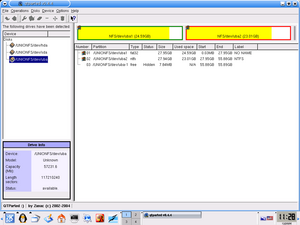
Information contained in the sectionalization table of an external hard drive every bit information technology appears in the utility plan QtParted, running under Linux
In improver to the bootstrap lawmaking and a sectionalization table, master boot records may contain a disk signature. This is a 32-bit value that is intended to place uniquely the deejay medium (every bit opposed to the disk unit of measurement—the two not necessarily being the aforementioned for removable hard disks).
The deejay signature was introduced by Windows NT version iii.5, merely it is now used by several operating systems, including the Linux kernel version 2.6 and later. Linux tools can use the NT disk signature to decide which disk the automobile booted from.[28]
Windows NT (and later Microsoft operating systems) uses the disk signature as an alphabetize to all the partitions on any disk ever connected to the figurer under that OS; these signatures are kept in Windows Registry keys, primarily for storing the persistent mappings between deejay partitions and drive letters. It may also be used in Windows NT BOOT.INI files (though well-nigh do not), to draw the location of bootable Windows NT (or afterwards) partitions.[29] One fundamental (amid many), where NT disk signatures appear in a Windows 2000/XP registry, is:
HKEY_LOCAL_MACHINE\SYSTEM\MountedDevices\
If a disk'south signature stored in the MBR was A8 E1 B9 D2 (in that order) and its first division corresponded with logical drive C: under Windows, then the REG_BINARY information under the key value \DosDevices\C: would be:
A8 E1 B9 D2 00 7E 00 00 00 00 00 00
The starting time four bytes are said disk signature. (In other keys, these bytes may appear in contrary order from that found in the MBR sector.) These are followed past eight more bytes, forming a 64-bit integer, in piffling-endian notation, which are used to locate the byte start of this partition. In this example, 00 7E corresponds to the hexadecimal value 0x7E00 ( 32,256). Under the assumption that the drive in question reports a sector size of 512 bytes, then dividing this byte beginning by 512 results in 63, which is the physical sector number (or LBA) containing the first sector of the sectionalisation (unlike the sector count used in the sectors value of CHS tuples, which counts from ane, the absolute or LBA sector value starts counting from zero).
If this disk had another partition with the values 00 F8 93 71 02 post-obit the disk signature (under, e.thousand., the key value \DosDevices\D:), it would begin at byte offset 0x00027193F800 ( 10,495,457,280), which is also the outset byte of physical sector 20,498,940.
Starting with Windows Vista, the disk signature is also stored in the Kick Configuration Data (BCD) store, and the kick process depends on it.[30] If the disk signature changes, cannot be plant or has a conflict, Windows is unable to boot.[31] Unless Windows is forced to use the overlapping part of the LBA accost of the Advanced Active Partition entry as pseudo-disk signature, Windows' usage is conflictive with the Avant-garde Active Partition feature of PTS-DOS 7 and DR-DOS 7.07, in item if their kick code is located outside the start 8 GB of the disk, and so that LBA addressing must be used.
Programming considerations [edit]
The MBR originated in the PC XT.[32] IBM PC-compatible computers are fiddling-endian, which means the processor stores numeric values spanning two or more than bytes in memory least significant byte showtime. The format of the MBR on media reflects this convention. Thus, the MBR signature will announced in a deejay editor as the sequence 55 AA.[a]
The bootstrap sequence in the BIOS will load the get-go valid MBR that it finds into the calculator'due south physical retention at address 0x0000:0x7C00.[32] The last instruction executed in the BIOS code will be a "jump" to that address in social club to straight execution to the outset of the MBR copy. The primary validation for virtually BIOSes is the signature at offset 0x01FE, although a BIOS implementer may cull to include other checks, such as verifying that the MBR contains a valid division table without entries referring to sectors beyond the reported capacity of the disk.
To the BIOS, removable (due east.g. floppy) and fixed disks are substantially the same. For either, the BIOS reads the first physical sector of the media into RAM at absolute address 0x7C00, checks the signature in the concluding two bytes of the loaded sector, and then, if the correct signature is found, transfers control to the first byte of the sector with a jump (JMP) educational activity. The only real stardom that the BIOS makes is that (by default, or if the boot order is non configurable) it attempts to kick from the get-go removable disk before trying to boot from the beginning fixed disk. From the perspective of the BIOS, the action of the MBR loading a book boot record into RAM is exactly the same as the activity of a floppy disk book boot record loading the object lawmaking of an operating organization loader into RAM. In either case, the program that the BIOS loaded is going about the work of chain loading an operating system.
While the MBR kick sector code expects to exist loaded at physical address 0x0000:0x7C00,[h] all the memory from physical accost 0x0000:0x0501 (accost 0x0000:0x0500 is the concluding one used by a Phoenix BIOS)[xiv] to 0x0000:0x7FFF,[32] later relaxed to 0x0000:0xFFFF [33] (and sometimes[i] up to 0x9000:0xFFFF)—the terminate of the kickoff 640 KB—is available in real style.[j] The INT 12h BIOS interrupt call may assist in determining how much memory tin can be allocated safely (by default, it simply reads the base memory size in KB from segment:starting time location 0x0040:0x0013, but it may be hooked by other resident pre-boot software like BIOS overlays, RPL code or viruses to reduce the reported amount of bachelor memory in club to keep other kicking stage software like boot sectors from overwriting them).
The final 66 bytes of the 512-byte MBR are reserved for the partition table and other data, so the MBR boot sector program must be minor enough to fit inside 446 bytes of retentiveness or less.
The MBR code examines the division tabular array, selects a suitable partition and loads the programme that will perform the next stage of the kicking process, usually by making use of INT 13h BIOS calls. The MBR bootstrap code loads and runs (a boot loader- or operating system-dependent) book boot record lawmaking that is located at the beginning of the "active" sectionalization. The volume kick record will fit inside a 512-byte sector, only information technology is prophylactic for the MBR lawmaking to load additional sectors to accommodate kicking loaders longer than 1 sector, provided they do not make any assumptions on what the sector size is. In fact, at least i KB of RAM is available at address 0x7C00 in every IBM XT- and AT-class machine, and then a one KB sector could be used with no trouble. Like the MBR, a book kicking tape normally expects to be loaded at address 0x0000:0x7C00. This derives from the fact that the book boot record pattern originated on unpartitioned media, where a volume boot tape would exist directly loaded by the BIOS kick procedure; every bit mentioned above, the BIOS treats MBRs and volume boot records (VBRs)[k] exactly akin. Since this is the same location where the MBR is loaded, one of the first tasks of an MBR is to relocate itself somewhere else in memory. The relocation address is adamant by the MBR, simply it is well-nigh often 0x0000:0x0600 (for MS-DOS/PC DOS, Os/2 and Windows MBR code) or 0x0060:0x0000 (nearly DR-DOS MBRs). (Even though both of these segmented addresses resolve to the same physical memory accost in real way, for Apple Darwin to boot, the MBR must be relocated to 0x0000:0x0600 instead of 0x0060:0x0000, since the code depends on the DS:SI arrow to the partition entry provided by the MBR, simply it erroneously refers to it via 0x0000:SI only.[34]) It is of import not to relocate to other addresses in memory because many VBRs volition assume a sure standard retentivity layout when loading their boot file.
The Status field in a partition table record is used to bespeak an active division. Standard-conformant MBRs will let but one partitioning marked active and employ this as part of a sanity-check to determine the existence of a valid partitioning table. They will display an error message, if more than 1 division has been marked active. Some non-standard MBRs will not treat this every bit an fault condition and but utilise the first marked division in the row.
Traditionally, values other than 0x00 (non active) and 0x80 (agile) were invalid and the bootstrap plan would display an mistake bulletin upon encountering them. However, the Plug and Play BIOS Specification and BIOS Kicking Specification (BBS) allowed other devices to become bootable as well since 1994.[33] [35] Consequently, with the introduction of MS-DOS seven.10 (Windows 95B) and higher, the MBR started to treat a gear up bit 7 every bit active flag and showed an error message for values 0x01..0x7F only. Information technology continued to treat the entry as physical drive unit to exist used when loading the corresponding partitioning's VBR later on, thereby now also accepting other kicking drives than 0x80 as valid, however, MS-DOS did not make use of this extension by itself. Storing the actual concrete drive number in the partition table does not normally cause backward compatibility problems, since the value will differ from 0x80 only on drives other than the first one (which take not been bootable before, anyhow). However, fifty-fifty with systems enabled to kick off other drives, the extension may still not piece of work universally, for case, after the BIOS assignment of physical drives has inverse when drives are removed, added or swapped. Therefore, per the BIOS Kick Specification (Bbs),[33] it is best practice for a modern MBR accepting bit seven equally active flag to pass on the DL value originally provided by the BIOS instead of using the entry in the partition table.
BIOS to MBR interface [edit]
The MBR is loaded at memory location 0x0000:0x7C00 and with the following CPU registers set up when the prior bootstrap loader (normally the IPL in the BIOS) passes execution to it by jumping to 0x0000:0x7C00 in the CPU's real manner.
- CS:IP = 0x0000:0x7C00 (fixed)
- Some Compaq BIOSes erroneously use 0x07C0:0x0000 instead. While this resolves to the same location in real mode memory, information technology is non-standard and should be avoided, since MBR lawmaking assuming certain register values or not written to exist relocatable may non piece of work otherwise.
- DL = kick drive unit (fixed disks / removable drives: 0x80 = first, 0x81 = second, ..., 0xFE; floppies / superfloppies: 0x00 = first, 0x01 = 2nd, ..., 0x7E; values 0x7F and 0xFF are reserved for ROM / remote drives and must non exist used on disk). [ citation needed ]
- DL is supported by IBM BIOSes besides as nearly other BIOSes. The Toshiba T1000 BIOS is known not to back up this properly, and some sometime Wyse 286 BIOSes utilise DL values greater or equal to 2 for fixed disks (thereby reflecting the logical drive numbers under DOS rather than the physical drive numbers of the BIOS). USB sticks configured as removable drives typically become an assignment of DL = 0x80, 0x81, etc. Notwithstanding, some rare BIOSes erroneously presented them under DL = 0x01, just as if they were configured every bit superfloppies.
- A standard conformant BIOS assigns numbers greater or equal to 0x80 exclusively to fixed deejay / removable drives, and traditionally only values 0x80 and 0x00 were passed on as physical drive units during kick. Past convention, only fixed disks / removable drives are partitioned, therefore, the but DL value a MBR could see traditionally was 0x80. Many MBRs were coded to ignore the DL value and work with a hard-wired value (unremarkably 0x80), anyway.
- The Plug and Play BIOS Specification and BIOS Kicking Specification (Bbs) let other devices to go bootable besides since 1994.[33] [35] The later recommends that MBR and VBR code should use DL rather than internally hardwired defaults.[33] This will also ensure compatibility with various non-standard assignments (see examples above), as far as the MBR code is concerned.
- Bootable CD-ROMs post-obit the El Torito specification may comprise disk images mounted by the BIOS to occur as floppy or superfloppies on this interface. DL values of 0x00 and 0x01 may besides be used by Protected Area Run Time Interface Extension Services (PARTIES) and Trusted Calculating Grouping (TCG) BIOS extensions in Trusted way to access otherwise invisible PARTIES partitions, deejay image files located via the Kicking Engineering Extension Record (BEER) in the last concrete sector of a hard disk's Host Protected Expanse (HPA). While designed to emulate floppies or superfloppies, MBR code accepting these non-standard DL values allows to employ images of partitioned media at to the lowest degree in the boot stage of operating systems.
- DH bit 5 = 0: device supported through INT 13h; else: don't intendance (should be goose egg). DH is supported by some IBM BIOSes.
- Some of the other registers may typically also concord sure register values (DS, ES, SS = 0x0000; SP = 0x0400) with original IBM ROM BIOSes, just this is zero to rely on, as other BIOSes may use other values. For this reason, MBR code by IBM, Microsoft, Digital Inquiry, etc. never did take whatever advantage of information technology. Relying on these register values in kicking sectors may also cause issues in chain-kicking scenarios.
Systems with Plug-and-Play BIOS or BBS support will provide a arrow to PnP data in addition to DL:[33] [35]
- DL = boot drive unit (come across above)
- ES:DI = points to "
$PnP" installation check structure
- This information allows the kick loader in the MBR (or VBR, if passed on) to actively interact with the BIOS or a resident PnP / BBS BIOS overlay in memory in order to configure the boot order, etc., however, this information is ignored by most standard MBRs and VBRs. Ideally, ES:DI is passed on to the VBR for later on use by the loaded operating organization, only PnP-enabled operating systems typically also accept fallback methods to retrieve the PnP BIOS entry point later on and then that most operating systems do not rely on this.
MBR to VBR interface [edit]
By convention, a standard conformant MBR passes execution to a successfully loaded VBR, loaded at retentivity location 0x0000:0x7C00, by jumping to 0x0000:0x7C00 in the CPU's real fashion with the post-obit registers maintained or specifically prepare:
- CS:IP = 0x0000:0x7C00 [l] (constant)
- DL = kicking drive unit (come across above)
- MS-DOS two.0-seven.0 / PC DOS 2.0-6.three MBRs exercise not laissez passer on the DL value received on entry, but they rather employ the boot status entry in the partition table entry of the selected primary segmentation as physical boot drive unit. Since this is, past convention, 0x80 in about MBR partition tables, it won't change things unless the BIOS attempted to boot off a physical device other than the outset stock-still deejay / removable drive in the row. This is also the reason why these operating systems cannot kick off a 2d hard disk, etc. Some FDISK tools allow to marker partitions on secondary disks every bit "active" besides. In this situation, knowing that these operating systems cannot boot off other drives anyway, some of them continue to employ the traditionally fixed value of 0x80 as agile marking, whereas others use values corresponding with the currently assigned physical drive unit (0x81, 0x82), thereby allowing to kick off other drives at least in theory. In fact, this will work with many MBR codes, which accept a set bit 7 of the boot status entry as active flag rather than insisting on 0x80, however, MS-DOS/PC DOS MBRs are hard-wired to accept the fixed value of 0x80 only. Storing the bodily physical drive number in the partition tabular array will also cause issues, when the BIOS assignment of physical drives changes, for example when drives are removed, added or swapped. Therefore, for a normal MBR accepting flake vii as active flag and otherwise merely using and passing on to the VBR the DL value originally provided by the BIOS allows for maximum flexibility. MS-DOS 7.one - 8.0 MBRs take changed to care for bit 7 equally active flag and whatsoever values 0x01..0x7F as invalid, but they notwithstanding accept the physical drive unit from the partition table rather than using the DL value provided by the BIOS. DR-DOS seven.07 extended MBRs treat flake 7 as active flag and utilise and pass on the BIOS DL value by default (including non-standard values 0x00..0x01 used past some BIOSes as well for partitioned media), only they also provide a special NEWLDR configuration block in guild to support culling kicking methods in conjunction with LOADER and Existent/32 too every bit to change the detail behaviour of the MBR, so that it can also work with bulldoze values retrieved from the partition tabular array (of import in conjunction with LOADER and AAPs, meet NEWLDR offset
0x000C), translate Wyse not-standard drive units 0x02..0x7F to 0x80..0xFD, and optionally fix upward the drive value (stored at showtime0x019in the Extended BIOS Parameter Block (EBPB) or at sector offset0x01FD) in loaded VBRs before passing execution to them (see NEWLDR outset0x0014)—this besides allows other boot loaders to apply NEWLDR equally a chain-loader, configure its in-retention prototype on the fly and "tunnel" the loading of VBRs, EBRs, or AAPs through NEWLDR.
- The contents of DH and ES:DI should exist preserved past the MBR for full Plug-and-Play support (encounter above), however, many MBRs, including those of MS-DOS ii.0 - 8.0 / PC DOS ii.0 - six.iii and Windows NT/2000/XP, exercise not. (This is unsurprising, since those versions of DOS predate the Plug-and-Play BIOS standard, and previous standards and conventions indicated no requirements to preserve whatsoever register other than DL.) Some MBRs set DH to 0.
The MBR code passes boosted data to the VBR in many implementations:
- DS:SI = points to the xvi-byte MBR partition table entry (in the relocated MBR) respective with the activated VBR. PC-MOS 5.1 depends on this to boot if no partition in the partition table is flagged as bootable. In conjunction with LOADER, Multiuser DOS and Existent/32 boot sectors utilize this to locate the boot sector of the agile segmentation (or another bootstrap loader similar IBMBIO.LDR at a fixed position on deejay) if the kick file (LOADER.SYS) could non be found. PTS-DOS half dozen.6 and Southward/DOS i.0 utilise this in conjunction with their Advanced Agile Partition (AAP) feature. In addition to support for LOADER and AAPs, DR-DOS 7.07 can use this to make up one's mind the necessary INT 13h access method when using its dual CHS/LBA VBR code and it will update the boot bulldoze / condition flag field in the sectionalization entry according to the effectively used DL value. Darwin bootloaders (Apple tree'southward
boot1h,boot1u, and David Elliott'southwardboot1fat32) depend on this pointer every bit well, just additionally they don't use DS, only assume it to be set up to 0x0000 instead.[34] This will crusade problems if this supposition is incorrect. The MBR code of OS/ii, MS-DOS 2.0 to 8.0, PC DOS 2.0 to 7.10 and Windows NT/2000/XP provides this same interface also, although these systems do non employ it. The Windows Vista/7 MBRs no longer provide this DS:SI arrow. While some extensions simply depend on the xvi-byte partition table entry itself, other extensions may require the whole iv (or 5 entry) segmentation table to be present too. - DS:BP = optionally points to the 16-byte MBR segmentation table entry (in the relocated MBR) corresponding with the activated VBR. This is identical to the arrow provided by DS:SI (see to a higher place) and is provided by MS-DOS ii.0-eight.0, PC DOS 2.0-7.10, Windows NT/2000/XP/Vista/7 MBRs. It is, however, not supported by most third-political party MBRs.
Under DR-DOS vii.07 an extended interface may be optionally provided by the extended MBR and in conjunction with LOADER:
- AX = magic signature indicating the presence of this NEWLDR extension (0x0EDC)
- DL = boot drive unit (see above)
- DS:SI = points to the 16-byte MBR sectionalization tabular array entry used (run across to a higher place)
- ES:BX = kickoff of kicking sector or NEWLDR sector paradigm (typically 0x7C00)
- CX = reserved
In conjunction with GPT, an Enhanced Disk Drive Specification (EDD) 4 Hybrid MBR proposal recommends another extension to the interface:[36]
- EAX = 0x54504721 ("
!GPT") - DL = boot drive unit (meet above)
- DS:SI = points to a Hybrid MBR handover structure, consisting of a 16-byte dummy MBR partitioning tabular array entry (with all $.25 ready except for the boot flag at showtime 0x00 and the partition type at offset 0x04) followed by additional data. This is partially compatible with the older DS:SI extension discussed above, if merely the 16-byte partition entry, not the whole sectionalisation table is required by these older extensions.
- Since older operating systems (including their VBRs) exercise not support this extension nor are they able to accost sectors across the 2 TiB barrier, a GPT-enabled hybrid boot loader should still emulate the sixteen-byte dummy MBR division table entry if the boot partition is located inside the first 2 TiB.[m]
- ES:DI = points to "
$PnP" installation check construction (see to a higher place)
Editing and replacing contents [edit]
Though information technology is possible to dispense the bytes in the MBR sector straight using various deejay editors, there are tools to write fixed sets of performance code to the MBR. Since MS-DOS 5.0, the program FDISK has included the switch /MBR, which will rewrite the MBR code.[37] Under Windows 2000 and Windows XP, the Recovery Console can exist used to write new MBR code to a storage device using its fixmbr command. Under Windows Vista and Windows seven, the Recovery Environment tin can be used to write new MBR lawmaking using the BOOTREC /FIXMBR command. Some third-party utilities may also be used for straight editing the contents of sectionalisation tables (without requiring any knowledge of hexadecimal or disk/sector editors), such every bit MBRWizard.[northward]
dd is also a ordinarily used POSIX command to read or write to whatever location on a storage device, MBR included. In Linux, ms-sys may be used to install a Windows MBR. The GRUB and LILO projects accept tools for writing code to the MBR sector, namely chow-install and lilo -mbr. The Grub Legacy interactive panel can write to the MBR, using the setup and embed commands, but GRUB2 currently requires chow-install to be run from within an operating organisation.
Various programs are able to create a "backup" of both the primary partition table and the logical partitions in the extended partition.
Linux sfdisk (on a SystemRescueCD) is able to save a fill-in of the primary and extended segmentation table. It creates a file that can be read in a text editor, or this file can be used by sfdisk to restore the primary/extended division table. An example command to support the sectionalisation table is sfdisk -d /dev/hda > hda.out and to restore is sfdisk /dev/hda < hda.out. Information technology is possible to re-create the division table from one disk to another this mode, useful for setting up mirroring, but sfdisk executes the command without prompting/warnings using sfdisk -d /dev/sda | sfdisk /dev/sdb.[38]
Meet also [edit]
- Extended boot record (EBR)
- Book kick record (VBR)
- GUID Partition Table (GPT)
- BIOS Boot sectionalization
- EFI Organization segmentation
- Boot technology extension record (BEER)
- Host protected area (HPA)
- Device configuration overlay (DCO)
- Apple partition map (APM)
- Amiga rigid disk block (RDB)
- Book Table of Contents (VTOC)
- BSD disklabel
- Boot loader
- Deejay cloning
- Recovery disc
- GNU Parted
- Partition alignment
Notes [edit]
- ^ a b c d e f one thousand The signature at offset 0x01FE in boot sectors is
55hex AAhex, that is 0x55 at offset 0x01FE andAAhexat offset 0x01FF. Since lilliputian-endian representation must be assumed in the context of IBM PC compatible machines, this tin can exist written as 16-bit wordAA55hexin programs for x86 processors (notation the swapped order), whereas it would have to be written as55AAhexin programs for other CPU architectures using a big-endian representation. Since this has been mixed upwardly numerous times in books and fifty-fifty in original Microsoft reference documents, this commodity uses the offset-based byte-wise on-disk representation to avoid any possible misinterpretation. - ^ In lodge to ensure the integrity of the MBR boot loader code, it is of import that the bytes at 0x00DA to 0x00DF are never changed, unless either all 6 bytes represent a value of 0 or the whole MBR bootstrap loader code (except for the (extended) partition table) is replaced at the same time as well. This includes resetting these values to
00 00 00 00 00 00hexunless the code stored in the MBR is known. Windows adheres to this rule. - ^ Originally, status values other than 0x00 and 0x80 were invalid, just modern MBRs treat the bit 7 every bit agile flag and utilise this entry to store the concrete boot unit.
- ^ a b The starting sector fields are limited to 1023+1 cylinders, 255+1 heads, and 63 sectors; catastrophe sector fields have the aforementioned limitations.
- ^ a b c d east The range for sector is 1 through 63; the range for cylinder is 0 through 1023; the range for head is 0 through 255 inclusive.[14]
- ^ a b The number of sectors is an index field; thus, the zero value is invalid, reserved and must not exist used in normal partition entries. The entry is used past operating systems in certain circumstances; in such cases the CHS addresses are ignored.[16]
- ^ "Quote: [About] versions of MS-DOS (including MS-DOS seven [Windows 95]) have a problems which prevents booting on difficult disks with 256 heads (FFh), so many modernistic BIOSes provide mappings with at nigh 255 (FEh) heads." RBIL[39] [forty]
- ^ The address
0000hex:7C00hexis the starting time byte of the 32nd KB of RAM. The loading of the kicking programme at this address historically was the reason why, while the minimum RAM size of an original IBM PC (type 5150) was 16 KB, 32 KB were required for the disk option in the IBM XT. - ^ If in that location is an EBDA, the bachelor memory ends below it.
- ^ Very onetime machines may accept less than 640 KB (
A0000hexor 655,360 bytes) of retention. In theory, merely 32 KB (up to0000hex:7FFFhex) or 64 KB (up to0000hex:FFFFhex) are guaranteed to exist; this would be the case on an IBM XT-class automobile equipped with only the required minimum amount of memory for a disk arrangement. - ^ This applies when the BIOS handles a VBR, which is when information technology is in the first physical sector of unpartitioned media. Otherwise, the BIOS has nothing to do with the VBR. The design of VBRs is such as it is because VBRs originated solely on unpartitioned floppy deejay media—the type 5150 IBM PC originally had no hard disk drive option—and the partitioning organisation using an MBR was later developed equally an adaptation to put more than one volume, each start with its own VBR as-already-defined, onto a single fixed disk. Past this pattern, substantially the MBR emulates the BIOS boot routine, doing the same things the BIOS would practise to procedure this VBR and gear up upwardly the initial operating environment for it just as if the BIOS had found that VBR on an unpartitioned medium.
- ^ IP is set as a result of the bound. CS may be set up to 0 either by executing a far bound or by loading the register value explicitly before executing a near jump. (It is impossible for jumped-to x86 code to observe whether a near or far jump was used to achieve information technology [unless the code that made the jump separately passes this data in some manner].)
- ^ This is not function of the above mentioned proposal, but a natural consequence of pre-existing conditions.
- ^ For case, PowerQuest's Segmentation Table Editor (PTEDIT32.EXE), which runs under Windows operating systems, is even so available hither: Symantec's FTP site.
References [edit]
- ^ Howe, Denis (2009-05-19) [1985]. "master boot record". FOLDOC. Archived from the original on 2017-08-24. Retrieved 2015-05-02 .
- ^ a b c d "Windows support for hard disks that are larger than 2 TB". 1. Microsoft. 2013-06-26. 2581408. Archived from the original on 2017-04-27. Retrieved 2013-08-28 .
- ^ a b c Sedory, Daniel B. (2004). "The Mystery Bytes (or the Bulldoze/Timestamp Bytes) of the MS-Windows 95B, 98, 98SE and Me Master Kick Record (MBR)". Master Kicking Records. thestarman.pcministry.com. Archived from the original on 2017-08-24. Retrieved 2012-08-25 .
- ^ Lucas, Michael (2003). Accented OpenBSD: Unix for the practical paranoid. p. 73. ISBN9781886411999 . Retrieved 2011-04-09 .
Every operating system includes tools to manage MBR partitions. Unfortunately, every operating organization handles MBR partitions in a slightly different manner.
- ^ Norton, Peter; Clark, Scott (2002). Peter Norton's New Inside the PC. Sams Publishing. pp. 360–361. ISBN0-672-32289-vii.
- ^ Graves, Michael W. (2004). A+ Guide To PC Hardware Maintenance and Repair. Thomson Delmar. p. 276. ISBN1-4018-5230-0.
- ^ Andrews, Jean (2003). Upgrade and Repair with Jean Andrews. Thomson Course Engineering. p. 646. ISBNane-59200-112-2.
- ^ Boswell, William (2003). Within Windows Server 2003. Addison-Wesley Professional. p. 13. ISBN0-7357-1158-5.
- ^ Smith, Roderick West. (2000). The Multi-Kick Configuration Handbook. Que Publishing. pp. 260–261. ISBN0-7897-2283-6.
- ^ Brouwer, Andries Evert (2004-04-22) [2000]. "Properties of segmentation tables". Partition types. Archived from the original on 2017-08-24. Retrieved 2017-08-24 .
Matthias [R.] Paul writes: "[…] PTS-DOS [uses] a special fifth sectionalization entry in front of the other four entries in the MBR and corresponding AAP-aware MBR bootstrap code. […]"
- ^ Brouwer, Andries Evert (2004-04-22) [2000]. "Properties of partition tables". Partitioning types. Archived from the original on 2017-08-24. Retrieved 2017-08-24 .
Some OEM systems, such as AST DOS (blazon
(NB. NEC MS-DOS 3.30 and AST MS-DOS partition tables with 8 entries are preceded with a signaturexivhex) and NEC DOS (type24hex) had eight instead of 4 partition entries in their MBR sectors. (Matthias R. Paul).A55Ahexat offset 0x017C.) - ^ Sedory, Daniel B. (2007-05-18) [2003]. "Notes on the Differences in one OEM version of the DOS 3.30 MBR". Master Boot Records. Archived from the original on 2017-08-24. Retrieved 2017-08-24 .
When we added partitions to this NEC table, the first one was placed at offsets 0x01EE through 0x01FD and the next entry was added just above it. So, the entries are inserted and listed backwards from that of a normal Tabular array. Thus, looking at such a Table with a deejay editor or partition listing utility, information technology would show the get-go entry in a NEC eight-entry tabular array as existence the final one (4th entry) in a normal Sectionalization Table.
(NB. Shows an 8-entry sectionalization table and where its boot code differs from MS-DOS 3.xxx.) - ^ "Division Table". osdev.org. 2017-03-18 [2007-03-06]. Archived from the original on 2017-08-24. Retrieved 2017-08-24 .
- ^ a b c System BIOS for IBM PC/XT/AT Computers and Compatibles. Phoenix technical reference. Addison-Wesley. 1989. ISBN0-201-51806-6.
- ^ Brouwer, Andries Evert (2013) [1995]. "List of division identifiers for PCs". Partition types. Archived from the original on 2017-08-24. Retrieved 2017-08-24 .
- ^ Wood, Sybil (2002). Microsoft Windows 2000 Server Operations Guide. Microsoft Press. p. 18. ISBN978-0-73561796-4.
- ^ "An Introduction to Difficult Disk Geometry". Tech Juice. 2012-12-06 [2011-08-08]. Archived from the original on 2013-02-04.
- ^ Kozierok, Charles Thou. (2001-04-17). "BIOS and the Hard Disk". The PC Guide. Archived from the original on 2017-06-17. Retrieved 2013-04-19 .
- ^ Smith, Robert (2011-06-26). "Working Around MBR'southward Limitations". GPT fdisk Tutorial. Archived from the original on 2017-08-24. Retrieved 2013-04-20 .
- ^ "More than 2 TiB on a MBR disk". superuser.com. 2013-03-07. Archived from the original on 2017-08-24. Retrieved 2013-10-22 .
- ^ "Transition to Advanced Format 4K Sector Difficult Drives". Tech Insight. Seagate Applied science. 2012. Archived from the original on 2017-08-24. Retrieved 2013-04-xix .
- ^ Calvert, Kelvin (2011-03-sixteen). "WD AV‐GP Large Chapters Hard Drives" (PDF). Western Digital. Retrieved 2013-04-xx .
- ^ Smith, Roderick W. (2010-04-27). "Linux on 4KB-sector disks: Practical communication". DeveloperWorks. IBM. Archived from the original on 2017-08-24. Retrieved 2013-04-19 .
- ^ a b "MBR (x86)". OSDev Wiki. OSDev.org. 2012-03-05. Archived from the original on 2017-08-24. Retrieved 2013-04-20 .
- ^ Sedory, Daniel B. (2003-07-xxx). "IBM DOS ii.00 Master Boot Record". The Starman's Realm. Archived from the original on 2017-08-24. Retrieved 2011-07-22 .
- ^ Singh, Amit (2009-12-25) [December 2003]. "Booting Mac OS 10". Mac OS X Internals: The Book. Retrieved 2011-07-22 .
- ^ de Boyne Pollard, Jonathan (2011-07-10). "The EFI boot process". Frequently Given Answers. Archived from the original on 2017-08-24. Retrieved 2011-07-22 .
- ^ Domsch, Matt (2005-03-22) [2003-12-xix]. "Re: RFC 2.6.0 EDD enhancements". Linux Kernel Mailing List. Archived from the original on 2017-08-24. Retrieved 2017-08-24 .
- ^ "Windows may utilize Signature() syntax in the BOOT.INI file". KnowledgeBase. Microsoft.
- ^ McTavish (Feb 2014). "Vista's MBR Disk Signature". Multibooters: Dual and Multibooting with Vista. Archived from the original on 2017-08-24. Retrieved 2017-08-24 .
- ^ Russinovich, Marking (2011-11-08). "Fixing Disk Signature Collisions". Mark Russinovich'due south Blog. Microsoft. Archived from the original on 2017-08-24. Retrieved 2013-04-nineteen .
- ^ a b c Sakamoto, Masahiko (2010-05-xiii). "Why BIOS loads MBR into
0x7C00in x86?". Glamenv-Septzen.net. Archived from the original on 2017-08-24. Retrieved 2011-05-04 . - ^ a b c d e f Compaq Figurer Corporation; Phoenix Technologies Ltd.; Intel Corporation (1996-01-xi). "BIOS Boot Specification ane.01" (PDF). ane.01. ACPICA. Archived (PDF) from the original on 2017-08-24. Retrieved 2013-04-20 . [1]
- ^ a b Elliott, David F. (2009-10-12). "Why does the "standard" MBR set SI?". tgwbd.org. Archived from the original on 2017-08-24. Retrieved 2013-04-xx .
- ^ a b c Compaq Reckoner Corporation; Phoenix Technologies Ltd.; Intel Corporation (1994-05-05). "Plug and Play BIOS Specification 1.0A" (PDF). 1.0A. Intel. Archived from the original (PDF) on 2017-08-24. Retrieved 2013-04-20 .
- ^ Elliott, Robert (2010-01-04). "EDD-iv Hybrid MBR boot code addendum" (PDF). Hewlett Packard, T13 Technical Committee. e09127r3. Archived (PDF) from the original on 2017-08-24. Retrieved 2013-04-xx .
- ^ "FDISK /MBR rewrites the Main Kicking Tape". Support. 1. Microsoft. 2011-09-23. 69013. Archived from the original on 2017-02-08. Retrieved 2013-04-19 .
- ^ "sfdisk(8) – Linux human being page". dice.net. 2013 [2007]. Archived from the original on 2017-08-24. Retrieved 2013-04-xx .
- ^ Brown, Ralf D. (2000-07-16). "Ralf Browns Interrupt List (v61 html)". Delorie Software. Retrieved 2016-11-03 .
- ^ Brown, Ralf D. (2000-07-16). "B-1302: INT 13 - DISK - READ SECTOR(Due south) INTO MEMORY". Ralf Brown's Interrupt List (RBIL) (61 ed.). Retrieved 2016-11-03 . (NB. See file INTERRUP.B inside archive "INTER61A.Nix.)
Further reading [edit]
- Gilbert, Howard (1996-01-01) [1995]. "Partitions and Volumes". PC Lube & Tune. Archived from the original on 2016-03-03.
- Knights, Ray (2004-12-22) [2000-12-xvi]. "Ray'southward Identify". MBR and Windows Boot Sectors (includes lawmaking disassembly and explanations of kicking process). Archived from the original on 2017-08-24. Retrieved 2017-08-24 .
- Landis, Hale (2002-05-06). "Master Boot Tape". How It Works. Archived from the original on 2014-07-01.
- Sedory, Daniel B. (2015-06-25) [2007]. "MBRs (Primary Boot Records)". Kicking Records Revealed. Archived from the original on 2017-08-24. Retrieved 2017-08-24 . [2] [three]
External links [edit]
- Commodity on master boot tape
- The MBR and how it fits into the BIOS boot procedure
hendersonmysecutage.blogspot.com
Source: https://en.wikipedia.org/wiki/Master_boot_record
0 Response to "C "Programming" How to Read Partition Table in First Boot Sector"
Post a Comment